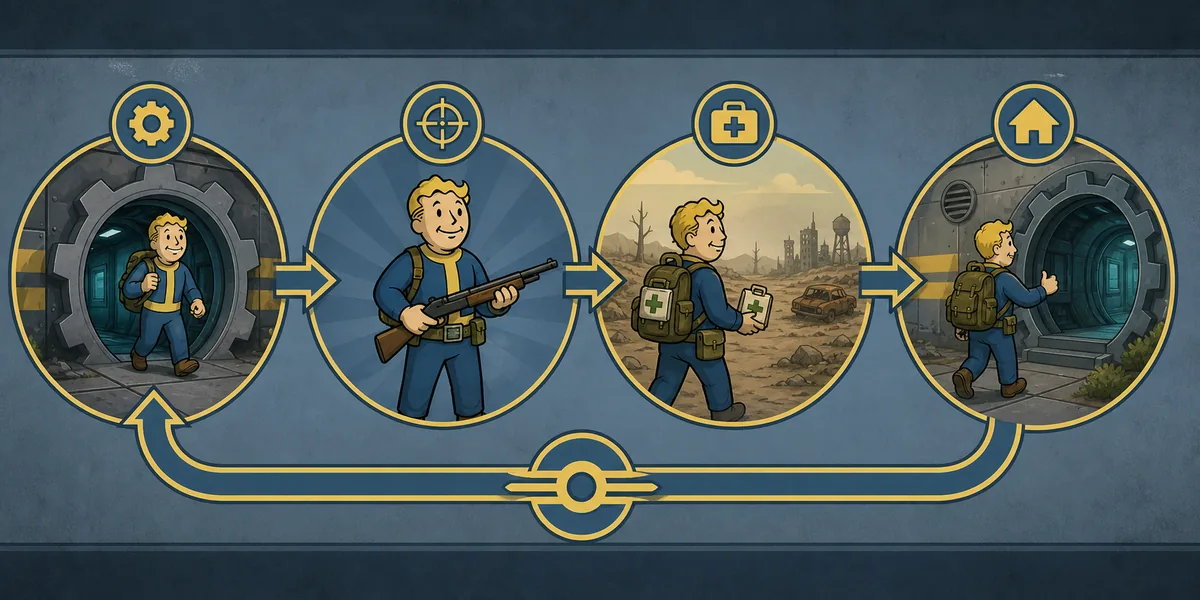
Quick Answer: The Best Stat Priority for Wasteland Explorers
If you need one short recommendation, use this order: Endurance first, Luck second, then Perception and Agility, followed by a broad all-round spread. Endurance gives the explorer a stronger long-term health foundation when trained before later level gains. Luck helps with caps and several reward or encounter checks. Perception and Agility support different exploration and combat situations, so they are better treated as part of a balanced build rather than a single magic stat.
That priority is a planning rule, not a guarantee of a particular legendary item or encounter. Fallout Shelter exploration uses many checks, and the result also depends on the dweller's level, effective stats from outfits, weapon damage, health, radiation, supplies, and the encounter itself. If a guide promises that one stat always produces the best loot, treat that claim carefully.
What Each SPECIAL Stat Does in the Wasteland
The broad Fallout Shelter SPECIAL stats guide explains every room and training use. For a wasteland run, the decision is narrower: which stats improve survivability, combat rhythm, or the chance of useful outcomes without leaving the vault's production team short-handed?
| Stat | Wasteland priority | How to use it | What not to assume |
|---|---|---|---|
| Endurance | First priority | Train it early for a stronger health foundation; it also supports longer trips and radiation resistance in commonly tested builds. | Raising it late recreates health that was missed during earlier level-ups. |
| Luck | High priority | Useful for Caps and several exploration or reward outcomes; it also supports critical-hit availability in fights. | Luck alone guarantees legendary loot or a perfect encounter. |
| Perception | Useful support | Helps some exploration checks and makes quest critical-hit timing easier to manage when the same dweller later joins a team. | Every location or loot result is controlled by Perception alone. |
| Agility | Useful support | Improves attack timing in combat and is a sensible companion stat for an explorer who may face repeated encounters. | Agility replaces weapon damage, health, or healing supplies. |
| Strength | Situational | Can matter in some checks and supports power-room work before or after the trip. | It is a universal damage multiplier for every wasteland fight. |
| Intelligence | Situational | Helps the dweller's vault role and can contribute to narrower checks; keep it balanced if the explorer also rotates through medical rooms. | A high Intelligence score fixes low health or weak combat gear. |
| Charisma | Lowest combat priority | Useful for the dweller's normal vault duties and some social or dialogue situations. | It is a reason to delay Endurance or send a fragile social dweller outside. |
Community testing is useful for spotting patterns, but hidden exploration formulas are not always presented as a complete official table. Use the table as a conservative build guide: prioritize the stats with the clearest practical value, then verify your own run instead of treating a single loot result as proof of a formula.

Explorer Builds for Different Vault Stages
There is no reason to hold a small vault until one perfect explorer exists. The best build changes with your population, training rooms, weapons, and supply buffer. Choose the version that your vault can actually support.
Why Endurance should be trained early
Endurance is the stat with the clearest timing issue. A dweller's health growth is affected by effective Endurance when the dweller levels, so training it after the dweller is already high level does not recreate the health that could have been gained earlier. That does not make a late Endurance increase useless: it can still help the current role and relevant exploration behavior. It simply means that a future explorer is worth planning before the leveling has already happened.
Why balanced stats are better than one extreme number
Exploration is not one repeated action. A dweller may travel, meet an enemy, find a location, open containers, lose health, gain radiation, or return with Caps and items. A balanced explorer has more ways to handle an unfamiliar event. If you only have time to train two stats, Endurance and Luck are a practical start; add Perception and Agility as the vault's production and training capacity improve.
Weapons, Outfits, Stimpaks, and RadAway
Stats do not operate in a vacuum. A well-trained explorer with a weak weapon or no recovery items can fail sooner than a moderately trained dweller with a complete loadout. The Fallout Shelter weapons and outfits guide covers broader role-based equipment choices; the wasteland-specific checklist is shorter.
| Loadout part | Priority | Decision rule |
|---|---|---|
| Weapon | Reliable damage | Use a strong, known weapon with a dependable damage range. Do not strip every vault defender just to create one perfect explorer. |
| Outfit | Role fit | Use Endurance, Luck, Perception, or Agility bonuses when they support the explorer's current stage. A large total SPECIAL number is not automatically the best field outfit. |
| Stimpaks | Damage recovery | Carry more than the smallest amount that worked once, especially for a new location or a higher-level explorer. Heal before the health bar becomes a last-pixel reaction test. |
| RadAway | Radiation control | Radiation reduces the usable health bar. Keep enough RadAway to recover from the trip rather than assuming Stimpaks can solve every problem. |
| Caps and space | Trip value | Check that the explorer can return with useful loot. If the run is already full or the risk has become high, the next encounter may not be worth it. |
Keep the main vault stable while the explorer is away. If the trip forces you to remove the best weapon from the entrance room, empty a critical production room, or spend all medical supplies, the expedition is too expensive for the current stage.
A Safer Wasteland Expedition Workflow
Use a repeatable routine so a good explorer does not become a one-off experiment. The same routine also makes save-editor troubleshooting easier because you know which change happened before the result.
- Choose the right dweller. Prefer a healthy, leveled candidate whose removal will not break a critical room. Check current health and radiation before departure.
- Train and equip by role. Train Endurance early when the dweller is still gaining levels. Add Luck, then improve Perception and Agility as your training rooms and outfits allow.
- Back up before unusual changes. If you are moving equipment, changing a large stat group, or testing a copied save, keep the untouched
Vault1.sav,Vault2.sav, orVault3.savoutside the active game folder. - Send a complete loadout. Confirm weapon, outfit, Stimpaks, RadAway, and the expected return value. Do not treat the expedition as a way to discover whether the dweller has any supplies.
- Review the run before extending it. A good early result does not mean the next location will be safe. Recall when the risk, radiation, or supply cost is no longer justified.
- Test the return. After the explorer arrives, confirm the dweller, inventory, health, and vault state. Create a fresh backup of the working save before another batch of edits.
When Should You Recall a Wasteland Explorer?
Recall is not a failure. The purpose of an expedition is to return with a living dweller and a useful result, not to keep the explorer outside until every possible minute has been consumed. Consider recalling when:
- the explorer's health is becoming difficult to recover safely;
- radiation is shrinking the usable health bar and RadAway is running low;
- the explorer is carrying enough value that another encounter would add little;
- your vault has lost too many strong defenders or a production shortage is developing;
- the explorer is testing a new build and you have already learned what you needed;
- the current file or equipment edit has not yet been proven stable.
A planned return also protects rare outfits and weapons. When the explorer comes home, check the vault normally before you start another field run. If the save does not load or the dweller state looks wrong, stop editing and use the Fallout Shelter save repair guide with the untouched backup.
Save-Editor Notes for Outside-the-Vault Data
This site can edit dweller and explorer-related save fields, but the fact that a field is visible does not mean that a mass edit is low risk. Outside-the-vault state can be connected to inventory, health, radiation, return timing, actor records, and the active vault slot. Treat it as a controlled test rather than a shortcut to max every value.
- Work on a copy and keep the original file untouched.
- Change one explorer or one small field group first.
- Keep base SPECIAL values within practical normal ranges; use outfits for ordinary effective bonuses.
- Avoid changing an explorer's inventory, health, return state, and actor records together.
- Restore the edited file only when Fallout Shelter is closed, then load the matching vault slot.
- If the result is stable, make a new backup before the next experiment.
For practical value boundaries across stats, health, levels, resources, and batch edits, read the Fallout Shelter max values guide. For the file workflow and cloud-conflict checks, use the cloud save, backup, and transfer guide. Those pages support this guide; they do not replace the core decision to build a healthy, well-equipped explorer.
Fallout Shelter Wasteland Explorer FAQ
What are the best stats for Fallout Shelter wasteland explorers?
Train Endurance first when the dweller is still leveling, then build Luck, Perception, and Agility into a balanced spread. Add a strong weapon, a useful outfit, and enough Stimpaks and RadAway for the trip. No single stat guarantees the best loot.
Is Endurance or Luck more important for wasteland exploration?
Endurance is the safer first priority because it supports the health gained during leveling and helps the explorer survive. Luck is an excellent second priority for Caps and several reward or encounter checks. Your build still needs gear and supplies.
Should every wasteland explorer have 10 in every SPECIAL stat?
No. A healthy, balanced explorer with reliable equipment is usually more useful than a fragile dweller whose stats were all forced to 10. Train the role's priorities and expand the build as your vault can support it.
What outfit is best for a Fallout Shelter explorer?
Use an outfit that supports the explorer's current role, usually Endurance, Luck, Perception, or Agility. A high total SPECIAL bonus is not automatically better if it does not improve survivability, combat, or the relevant exploration checks.
When should I recall an explorer?
Recall when health or radiation is becoming risky, supplies are nearly empty, the vault needs the dweller back, or the next encounter is not worth the potential loss of a trained dweller and rare gear. A safe return is a successful expedition.
Can I use a save editor to change explorer stats?
You can edit a copied save, but explorer, inventory, and outside-the-vault fields may be more fragile than ordinary resource edits. Keep the original backup, make a small change, restore only with the game closed, and test the vault before continuing.
Sources and Verification Notes
The official game listing describes sending dwellers into the wasteland and developing their S.P.E.C.I.A.L. abilities. Exact exploration outcomes and hidden formulas are less transparent, so this guide separates conservative practical advice from claims that should be treated as community-tested rather than guaranteed.
- Fallout Shelter on Steam — official game listing and store media.
- Fallout Wiki: Fallout Shelter SPECIAL — community-maintained reference for stat roles and exploration notes.
- The Fallout Shelter FAQ: SPECIAL — community testing notes for Endurance, quests, and exploration behavior.
Final Recommendation
For most vaults, the strongest wasteland plan is simple: train Endurance before the explorer gains many levels, add Luck, build Perception and Agility without neglecting health, equip dependable damage, carry medical supplies, and recall before the risk becomes irreversible. The best explorer is not the one with the largest visible numbers; it is the one who can leave, handle the trip, and return without destabilizing the vault.